
Discover how Model Context Protocol is changing the way businesses connect AI with their data and how Rankley’s AI assistant helps turn that data into answers.
Introduction
Every business today is swimming in data.
Google Analytics tracks your traffic.
Microsoft Clarity shows heatmaps and user sessions.
Google Search Console reveals how people discover your site.
The problem? Making sense of it all.
Dashboards are complex. Integrations are messy. Custom APIs take time and technical expertise.
That’s where Model Context Protocol (MCP) comes in.
MCP is a new open standard designed to make it easier for AI models to securely connect to external data sources and tools. In simple terms, it’s a universal plug that allows AI assistants to pull in data without building custom integrations for every app.
If you’ve ever wished you could simply ask your data a question and get a clear answer, MCP is the foundation that makes it possible.
What Is Model Context Protocol (MCP)?
Model Context Protocol (MCP) is a specification that standardizes how AI systems connect to external data and services.
Instead of building one-off connectors for every application, MCP provides a shared language that allows systems to talk to each other securely and consistently.
Think of it like USB for data.
Before USB, every device had its own cable. With USB, everything became plug-and-play. MCP does the same thing for AI-to-data connections.
MCP was introduced in late 2023 by OpenAI and ecosystem partners, and adoption is growing rapidly across analytics, productivity, and developer tools.
Why MCP Matters for Businesses
For business owners, marketers, and agencies, MCP solves major data pain points:
- Speed: Connect tools in minutes instead of weeks of development
- Security: Standardized permissions make access easier to control and audit
- Scalability: Add new MCP-enabled tools without rebuilding integrations
- Accessibility: Non-technical teams can finally work directly with data
MCP lowers the barrier between your business questions and the data that answers them.
Examples of MCP Connectors
The MCP ecosystem is growing quickly. Relevant connectors include:
- Google Analytics MCP: Traffic, conversions, audiences
https://developers.google.com/analytics - Microsoft Clarity MCP: Heatmaps and session recordings
https://clarity.microsoft.com/ - GitHub MCP: Code repositories and workflows
https://github.com/github - DataForSEO MCP: Keyword rankings and SERP data
https://dataforseo.com
How MCP Connects AI to Data
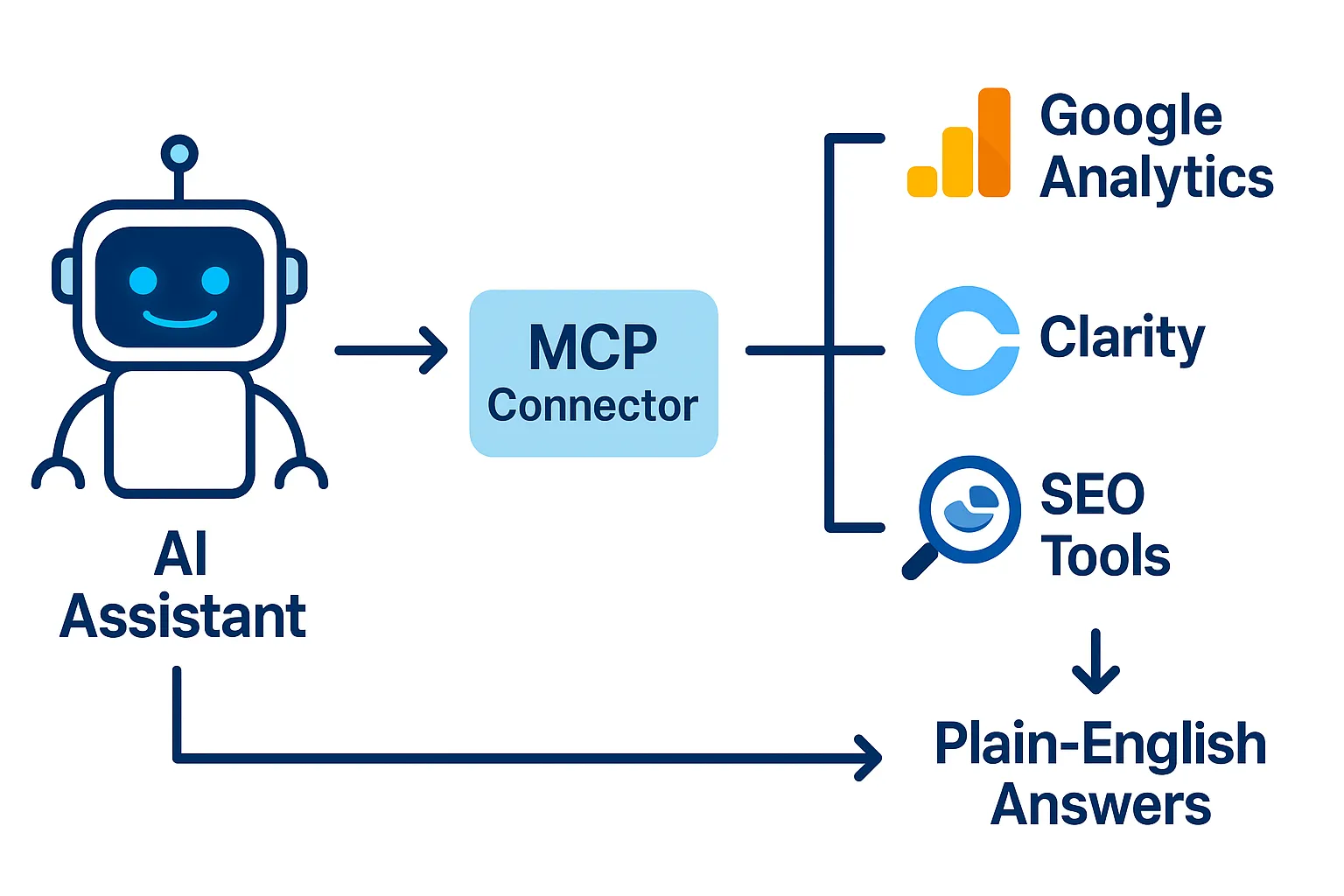
Explainer diagram showing how MCP connects AI assistants to analytics and SEO tools to deliver plain-English insights.
MCP removes the heavy lifting. Once connected, your AI assistant can access these tools without custom logic for each one.
From Data Access to Insights
MCP solves the access problem, but access alone isn’t enough.
Businesses still ask:
- “What does this data actually mean?”
- “What should I do next?”
With MCP + AI, you can ask plain-English questions like:
- “What were my top traffic sources last month?”
- “Which landing pages have the highest bounce rate?”
- “Why are users dropping off my signup form?”
Instead of charts, you get answers and recommendations.
Introducing Rankley’s AI Local SEO Assistant
At Rankley, we believe MCP is most powerful when paired with AI that understands local SEO context.
Rankley’s AI Local SEO Assistant connects directly to:
- Google Analytics
- Google Search Console
- Google Business Profile
And lets you chat with your data.
Example:
User: How is my Google Business Profile performing this month?
Rankley: Impressions are up 22%, but clicks are down 9%. I recommend adding new photos and posting an update to boost engagement.
User: Which keywords should I focus on to rank higher locally?
Rankley: You’re close to page one for “SEO agency near me.” Optimizing your service page could push you higher.
No dashboards. No jargon. Just answers.
Real-World Use Cases
MCP + AI benefits different teams in different ways:
- Agencies Chat across multiple client accounts without tab switching
- Business owners Get simple answers without analytics expertise
- Marketing teams Spot conversion drops and growth opportunities faster
The outcome is always the same: better decisions, faster.
The Future of MCP and AI Assistants
MCP is on track to become the standard for AI-to-tool connectivity.
As more services adopt MCP, AI assistants will become the primary interface for business intelligence.
Soon, “What’s happening in my business?” won’t mean logging into five dashboards. It’ll mean asking one question.
Industry analysts already point to MCP as a foundational protocol for AI workflows: https://www.sentinel.com/resources/blog/sentinel-blog/2025/05/21/the-great-ai-connector--why-mcp-is-your-next-strategic-move
Conclusion
So what is Model Context Protocol?
It’s the foundation that makes AI-to-data connections simple, secure, and scalable.
But access alone isn’t enough. You need AI that turns data into clear, actionable guidance.
That’s exactly what Rankley’s AI Local SEO Assistant does: helping businesses understand their analytics, rankings, reviews, and local visibility without complexity.
Stay tuned for upcoming guides on:
- How to use Google Analytics MCP
- How to use Microsoft Clarity MCP
In the meantime, experience what it’s like to chat with your SEO data inside Rankley.

Published by Rankley Editorial
The Rankley team shares practical guides, tools, and insights to help local businesses get found online.