
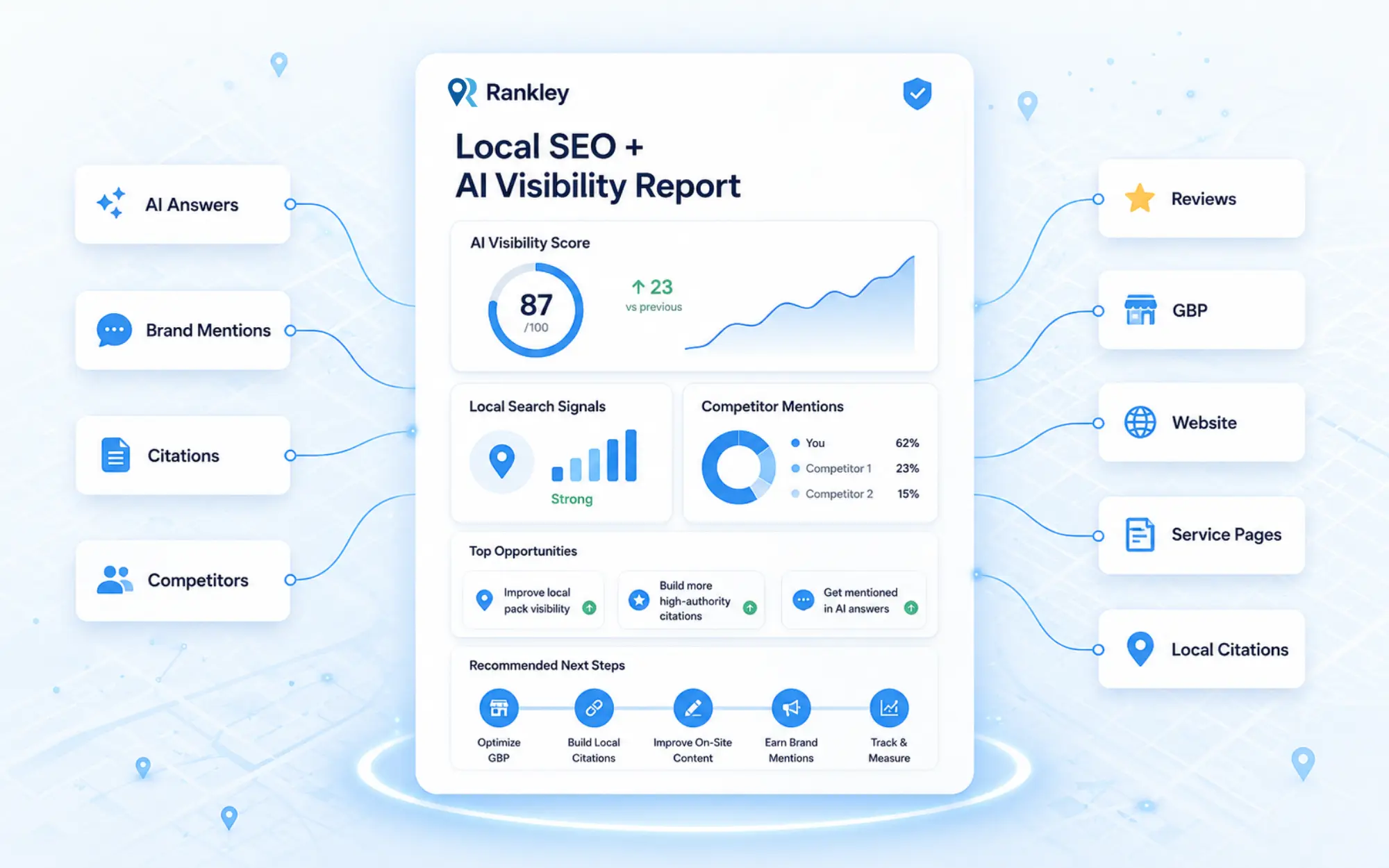
AI visibility tool category comparison
Rankley vs AI Visibility Tools
AI visibility tools help teams monitor how brands appear in AI answers. Rankley helps agencies turn local SEO and AI visibility insights into white-label audits, prospect reports, and client-ready recommendations.
Rankley is best for
Agency-ready AI visibility audits with local SEO context
AI visibility tools are best for
Ongoing prompt, brand mention, and citation monitoring
Main difference
Client-ready reports vs internal monitoring dashboards
Page updated
2026-05-30
On this page
Choose based on how you need to use the insight
Choose Rankley when your goal is to explain AI visibility to local business owners, package findings into branded reports, and use the audit in sales, onboarding, or retention workflows. Choose dedicated AI visibility tools when your team needs deep, ongoing AI answer monitoring across many prompts, brands, markets, or answer engines.
Choose Rankley if...
Recommended- You need local SEO + AI visibility audits for prospects, SMB clients, or multi-location accounts.
- You want white-label report delivery with share links or PDFs for client conversations.
- Your team runs prospecting and sales-stage audit workflows that must move quickly.
- You need AI visibility framed in local SEO context, not as raw monitoring output.
- You want clear, prioritized recommendations non-technical stakeholders can act on.
- Your focus is client-ready communication for onboarding and retention reviews.
Quick takeaway
If you need prospect-first local audits with clear next steps and shareable outputs, Rankley fits the sales-stage workflow.
Choose AI Visibility Tools if...
- You need ongoing prompt tracking across many queries, brands, competitors, and markets.
- You need consistent brand mention monitoring across AI answers and engines over time.
- Citation and source tracking is a core workflow, not an occasional audit input.
- Your SEO/content team has internal analysts for ongoing monitoring and interpretation.
- You prioritize internal observability dashboards over client-ready report delivery.
- Your main deliverable is monitoring depth rather than sales-stage audit packaging.
All tools have strengths choose based on your workflow and depth needed.
Key differences that matter in real workflows
A fast, fair breakdown of how Rankley compares to AI Visibility Tools so you can choose based on how you work.
Reporting output: deliverable vs dashboard
Both options surface AI visibility data, but they package outcomes differently
Rankley
- White-label reports built for agencies.
- Share links and PDFs for client conversations.
- Client-ready narrative with clear next steps.
AI Visibility Tools
- Dashboards optimized for internal teams.
- Great for ongoing monitoring, not packaged delivery.
- Often needs extra reporting translation for clients.
Local SEO context: actionable signals vs broad tracking
If local visibility is part of your client deliverable, context matters as much as monitoring breadth
Rankley
- Connects AI visibility with local SEO signals.
- Highlights what matters for SMB and multi-location accounts.
- Turns findings into client-facing priorities.
AI Visibility Tools
- Broad brand observability across prompts and engines.
- Strong for internal tracking at scale.
- Local context may need separate interpretation.
Prospecting workflow: sales motion vs analyst motion
Agency teams usually need to move from audit to conversation quickly
Rankley
- Designed for prospecting and sales-stage audits.
- Fast handoff from findings to client presentation.
- Useful in onboarding and retention reviews.
AI Visibility Tools
- Excellent for continuous internal analysis.
- Less focused on sales-call-ready packaging.
- Often requires extra synthesis before client use.
Monitoring depth: operational observability at scale
Dedicated AI visibility platforms are generally stronger for always-on tracking programs
Rankley
- Strong for audit snapshots and report delivery.
- Good for framing opportunities in client language.
- Not a full enterprise observability suite.
AI Visibility Tools
- Deep prompt monitoring across large query sets.
- Citation tracking and source analysis at scale.
- Brand mention monitoring for internal SEO/content teams.
Recommendations: clear next steps vs raw signal review
The practical difference is how easily data turns into decisions
Rankley
- Client-facing recommendations in plain language.
- Prioritized actions aligned to local SEO goals.
- Useful when agencies must explain what to do next.
AI Visibility Tools
- Strong raw signal visibility for expert teams.
- Great when internal analysts drive interpretation.
- Less focused on prescriptive client-ready action plans.
Compare Rankley with AI visibility tools
See where Rankley fits best for agency reporting and where dedicated AI visibility platforms fit best for ongoing monitoring.
How to read this: each row includes a one-line “why it matters” and a quick capability note.
Choose Rankley for client-ready audits
- You need local SEO + AI visibility audits clients can understand quickly.
- You want white-label reports with share links and PDFs.
- Your workflow centers on prospecting, sales calls, onboarding, and retention.
- You need client-facing recommendations, not just raw monitoring data.
Choose AI tools for ongoing monitoring
- You need ongoing prompt monitoring across many queries and markets.
- Brand mention monitoring is a core internal workflow.
- Citation and source tracking are required at scale.
- Your SEO/content team uses internal observability for analysis and planning.
Use both for advanced workflows
- Use AI visibility tools for deep monitoring, then package findings in client-ready reports.
- You need both internal observability and agency-style delivery.
- Your team wants monitoring depth without losing stakeholder clarity.
Best for sales-stage & prospecting
Primary use case
What each option is mainly designed to support.
Rankley
AI Visibility Tools
Best-fit user
Who tends to get the most value from the workflow.
Rankley
AI Visibility Tools
Prospecting workflow
Usefulness in pre-sale and new-business conversations.
Rankley
AI Visibility Tools
Sales-stage audit workflow
Designed to support audit-led selling and onboarding.
Rankley
AI Visibility Tools
Local SEO & visibility audits
Local SEO context
How naturally AI visibility insights connect to local visibility work.
Rankley
AI Visibility Tools
Client-ready recommendations
How easily findings become clear next steps for stakeholders.
Rankley
AI Visibility Tools
Reporting & stakeholder outputs
White-label reporting
Support for agency-branded deliverables.
Rankley
AI Visibility Tools
PDF/shareable report output
How easily work can be shared with clients or prospects.
Rankley
AI Visibility Tools
How the workflows actually differ
One approach is optimized for fast, client-ready audits you can act on. The other is optimized for ongoing research, monitoring, and iterative optimization.
Pick → audit → review → report → share
- 1
Pick a prospect or client
Start with a specific account, location, or opportunity.
- 2
Run a local SEO + AI visibility audit
Surface visibility signals in a workflow built for agencies and consultants.
- 3
Review gaps, competitors, and local signals
Translate the findings into a practical story a client can understand.
- 4
Generate a white-label report
Package the audit into a branded output that is easy to send.
- 5
Share before a sales call, during onboarding, or in monthly reporting
Use the report where it supports the next client conversation.
Outcome
A client-ready audit story with local SEO context and clear next steps.
Define → monitor → review → interpret → report
- 1
Define prompts, topics, markets, and competitors
Set the monitoring scope before you start tracking.
- 2
Monitor AI answers over time
Track visibility across answer engines on a recurring basis.
- 3
Review mentions, citations, sentiment, and competitor presence
Look for patterns and shifts in how the brand appears.
- 4
Interpret patterns internally
Turn the data into internal analysis and decisions.
- 5
Build separate reporting or strategy docs
Create stakeholder-facing materials outside the monitoring workflow.
Outcome
Ongoing AI visibility monitoring that feeds into internal analysis and reporting.
FAQs
Quick, plain-language answers teams ask when comparing Rankley and AI Visibility Tools.
These cover the most common objections and decision points before choosing a tool.
Need help deciding?
Tell us your workflow • we’ll recommend the cleanest setup.
Related resources
Use these guides, feature pages, and comparison hubs to understand where this comparison fits in a broader agency workflow.
Browse all workflow-based comparisons for agencies and consultants.
Open →See how Rankley packages AI visibility insights into practical reporting.
Open →Explore the local SEO audit workflow behind client-ready findings.
Open →Review the white-label sharing and reporting options used in agency delivery.
Open →A 2026 buyer’s guide for agencies and consultants.
Open →Comparisons and buyer’s guides for agency tool stacks.
Open →Turn AI visibility into a report your clients understand
Use Rankley to connect AI visibility signals with local SEO context, then package the findings into white-label reports for prospects, clients, and sales conversations.
- Prospect-ready audit in minutes
- White-label share link or PDF
- Built for agencies, freelancers, and consultants
No hard pitch - 15 minutes - Built for agencies, freelancers, and consultants