On this page
- Introduction
- Local SEO Myth #1: “Local SEO Isn’t Important for My Business”
- Local SEO Myth #2: “More Citations Mean Better Rankings”
- Local SEO Myth #3: “You Must Use ‘Near Me’ Keywords Everywhere”
- Local SEO Myth #4: “Reviews Don’t Affect Local Rankings”
- Local SEO Myth #5: “Only the #1 Local Pack Spot Matters”
- Local SEO Myth #6: “You Don’t Need Schema Markup for Local SEO”
- Local SEO Myth #7: “Local SEO Is Set-and-Forget”
- Actionable Strategies That Actually Work in 2025
- 1) Fully optimize and update your Google Business Profile weekly
- 2) Prioritize high-quality, consistent citations
- 3) Encourage and respond to authentic reviews
- 4) Create hyper-local content that solves real problems
- 5) Implement and validate schema markup
- 6) Ensure mobile-first performance and conversion UX
- Conclusion: Bust these Local SEO myths and win in 2025
Persistent Local SEO myths waste time and can hurt rankings. In 2025, Google’s local algorithms reward accuracy, engagement, and speed not shortcuts. This guide busts the biggest Local SEO myths and shows what actually works.
Introduction
Local SEO is still one of the highest-ROI channels for service-area and storefront businesses, yet misleading advice keeps circulating. Many Local SEO myths started as partial truths years ago and no longer reflect how search works today. In 2025, AI-driven ranking systems evaluate trust, usefulness, and real customer actions. If you still rely on outdated tactics, you’ll fall behind faster than ever.
Below we break down seven common Local SEO myths why they persist, how they backfire, and the proven strategies that replace them.
 Caption: AI and data are untangling outdated Local SEO misconceptions.
Local SEO Myth #1: “Local SEO Isn’t Important for My Business”
Reality: Local intent shows up across a huge share of searches, especially on mobile. When people are ready to act: call, visit, or book, Google surfaces nearby options first. Treating Local SEO as optional hands demand to competitors who optimize their presence.
Why this myth persists: National or B2B brands assume local ranking doesn’t apply. But Google tailors results by location even for broad queries, routing buyers to solutions that are physically or service-area relevant.
Example: An injury attorney thinks “we rank organically already.” Yet their phone volume spikes after improving their Google Business Profile (GBP), adding local FAQs, and speeding up mobile pages, the very Local SEO levers they’d ignored.
Local SEO Myth #2: “More Citations Mean Better Rankings”
Reality: Quality and consistency beat volume. A curated set of authoritative, niche-relevant listings outperforms hundreds of thin directories. One inconsistent NAP (Name, Address, Phone) can dilute trust across the ecosystem.
Why this myth persists: Years ago, bulk submissions worked. Today, Google devalues low-quality networks and rewards accuracy, prominence, and user signals instead.
- Prioritize reputable directories (industry associations, Chamber of Commerce, major review platforms).
- Run quarterly audits to fix duplicates and ensure NAP matches your site.
 Caption: Fewer, consistent, high-quality citations outperform hundreds of spammy listings.
Local SEO Myth #3: “You Must Use ‘Near Me’ Keywords Everywhere”
Reality: Google infers location and intent; stuffing exact “near me” phrases is unnecessary and can harm UX. Instead, write naturally with city, neighborhood, and landmark references where they help users.
Why this myth persists: Early case studies showed wins from exact-match terms. In 2025, conversational intent and proximity signals do the heavy lifting supported by a complete GBP and clear on-site details.
Do this instead: Build focused location + service pages, add embedded maps, list service areas, and answer common local FAQs. Use Search Console to find how real customers phrase queries.
Local SEO Myth #4: “Reviews Don’t Affect Local Rankings”
Reality: Reviews influence both visibility and conversions. Google evaluates volume, velocity, and sentiment, plus how often you respond. A steady stream of specific, recent reviews is one of the strongest local signals.
Why this myth persists: Some businesses see traffic without reviews and assume they’re optional. Then a competitor earns consistent 4.7+ feedback, engages publicly, and leapfrogs them in the map pack.
- Request reviews after every job; make it easy with direct profile links.
- Reply to all feedback within 24–48 hours; highlight resolutions.
- Feature top reviews on key pages with Review schema.
 Caption: Positive reviews and timely responses drive higher trust and local search visibility.
Local SEO Myth #5: “Only the #1 Local Pack Spot Matters”
Reality: Rank helps, but engagement wins. A #2 result with better photos, richer info, and faster response times can earn more calls than a stagnant #1. Google learns from user actions and reshuffles accordingly.
Why this myth persists: Legacy SEO thinking over-values position and under-values conversions. In 2025, complete, helpful profiles with active posts often outperform higher but weaker listings.
Tip: Treat your GBP like a landing page: FAQs, offers, appointment links, and current photos. Monitor which elements drive calls and messages.
Local SEO Myth #6: “You Don’t Need Schema Markup for Local SEO”
Reality: Schema helps search engines understand and feature your content. LocalBusiness, FAQ, Review, and Event schema support rich results that lift CTR and trust.
Why this myth persists: Some sites rank without it, so teams assume schema is optional. But structured data enhances eligibility for rich experiences and AI-driven summaries, which is increasingly valuable.
Validate and learn from Google’s docs on structured data, and fix errors promptly in Search Console.
 Caption: LocalBusiness, Review, and FAQ schema help Google understand and display business details accurately.
Local SEO Myth #7: “Local SEO Is Set-and-Forget”
Reality: Local SEO is ongoing. Competitors update weekly, guidelines evolve, and customer expectations rise. A “done once” site or listing decays in visibility over time.
Why this myth persists: Teams conflate a one-time site build with continuous optimization. In 2025, freshness, responsiveness, and proof of service quality are baseline expectations.
- Weekly: GBP posts, Q&A updates, photo refreshes.
- Monthly: citation checks, content updates, internal link improvements.
- Quarterly: backlink audits, competitor review, conversion UX tuning.
 Caption: Local SEO success requires consistent updates, monitoring, and optimization not one-time fixes.
Actionable Strategies That Actually Work in 2025
1) Fully optimize and update your Google Business Profile weekly
- Complete every field; enable messaging/booking; keep hours accurate.
- Post offers, events, or product highlights weekly to signal freshness.
- Add 5–10 new photos monthly; monitor which images drive calls.
- Docs: Google Business Profile Help
2) Prioritize high-quality, consistent citations
- Focus on authoritative, human-vetted directories; avoid bulk spam networks.
- Run quarterly NAP audits; ensure your site is the single source of truth.
3) Encourage and respond to authentic reviews
- Target steady review velocity (for example, 10–15/month) with specifics about services and neighborhoods.
- Reply to every review within 24–48 hours; emphasize outcomes and gratitude.
4) Create hyper-local content that solves real problems
- Neighborhood guides, service + city landing pages, event recaps, before/after case studies.
- Use conversational FAQs to target voice queries and “open now” intent.
- See also: Mastering Local SEO in 2025
5) Implement and validate schema markup
- Add LocalBusiness, Review, Event, and FAQ schema where relevant.
- Validate monthly using Google’s structured data documentation.
6) Ensure mobile-first performance and conversion UX
- Target LCP $\le 2.5s$, CLS $< 0.1$; compress images (WebP/AVIF), lazy-load media.
- Make primary actions obvious: click-to-call, directions, book now.
- Related: Mobile-First Local SEO
Conclusion: Bust these Local SEO myths and win in 2025
The fastest way to improve results is to retire the habits that no longer work. By dismantling these seven Local SEO myths and replacing them with data-backed practices, you’ll align with how Google actually ranks local results in 2025.
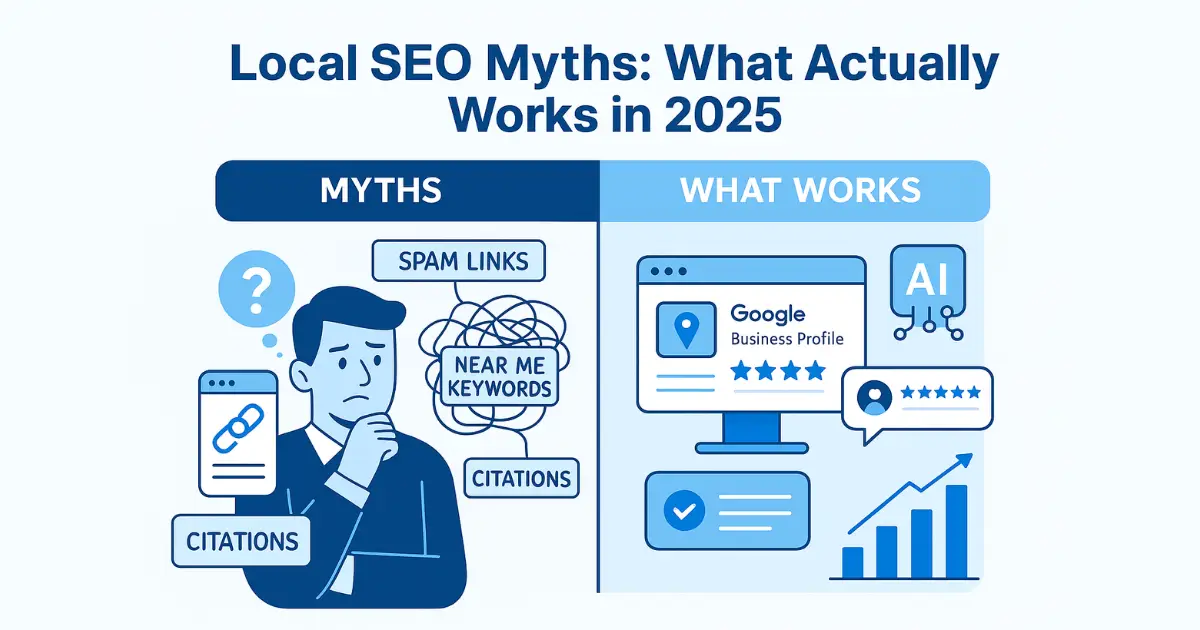
 Caption: The difference between outdated SEO myths and modern, data-driven local search strategies.
- Treat Local SEO as ongoing not a one-time task.
- Optimize GBP weekly; respond to every review.
- Curate authoritative citations; keep NAP 100% consistent.
- Publish helpful, hyper-local content; answer real questions.
- Implement LocalBusiness, Review, Event, and FAQ schema. Validate monthly.
- Prioritize mobile speed and clear conversion paths.
Keep iterating, measure what customers actually do, and your visibility will compound without falling for the same old Local SEO myths.

Published by Rankley Editorial
The Rankley team shares practical guides, tools, and insights to help local businesses get found online.