
On this page
- Introduction
- What is an AI Visibility Audit?
- Why Are AI Visibility Audits Easier to Sell Right Now?
- Step 1: How Do You Identify the Best Prospects for AI Visibility Audits?
- Step 2: What Should an AI Visibility Audit Include?
- 1. Entity Clarity
- 2. Review Volume & Sentiment
- 3. Directory Presence
- 4. Website Content Alignment
- 5. Brand Mentions
- 6. Engagement Signals
- 7. Structured Data & Context
- Step 3: How Should You Package an AI Visibility Audit for Clients?
- ✅ Show a clear score
- ✅ Highlight strengths
- ✅ Identify weaknesses
- ✅ Provide actionable recommendations
- Step 4: How Do You Close the Deal and Upsell Ongoing Work?
- 🔹 One-Time Audit
- 🔹 Optimization Package
- 🔹 Monthly AI Visibility Monitoring
- The AI Visibility Signals (Simplified Framework)
- Download the AI Visibility Audit Checklist
- How to Scale This Without Doing Everything Manually
- FAQ: How Do You Sell AI Visibility Audits to Local Clients?
- How much should you charge for an AI visibility audit?
- What should an AI visibility audit include?
- Is an AI visibility audit a one-time service or a monthly retainer?
- How do you explain AI visibility audits to local business owners?
- Final Thoughts
- Next Step
If you want to learn how to sell AI visibility audits to local clients, the opportunity is straightforward: local businesses can already feel AI changing discovery, but most still do not know how to measure it, explain it, or improve it. Agencies that can package that uncertainty into a clear audit, score, and action plan can turn AI visibility into a new revenue line instead of a vague trend.
Introduction
AI is changing how people discover local businesses, and most agencies are still selling yesterday's SEO conversation.
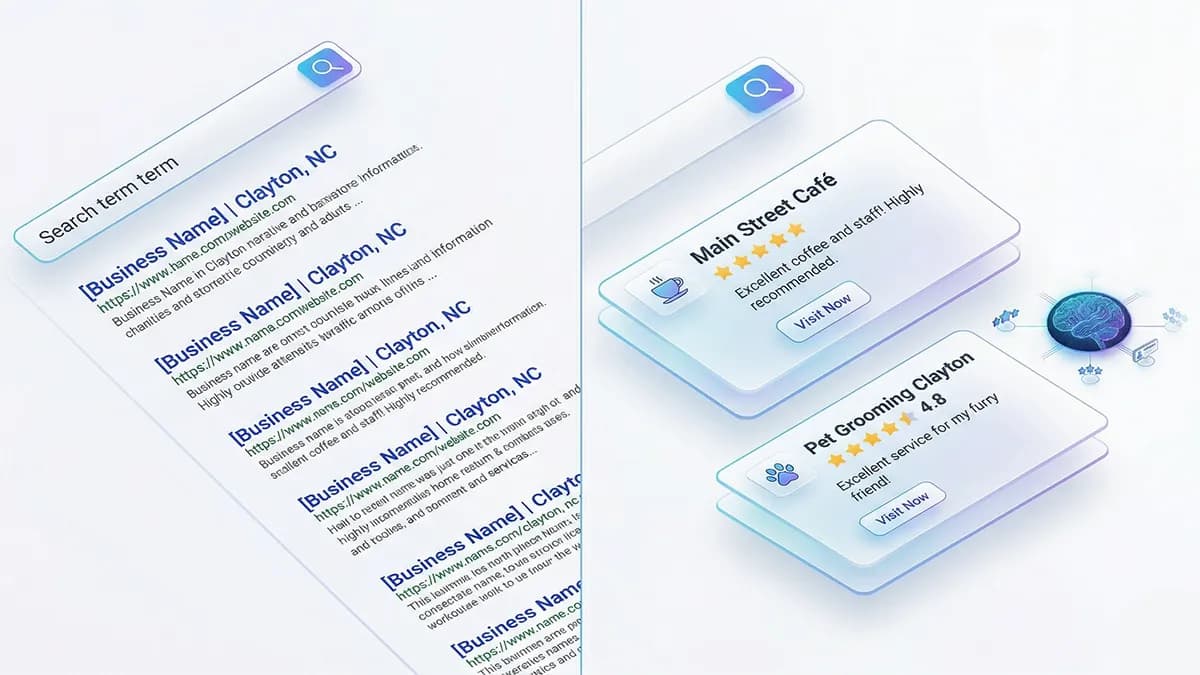
Instead of scrolling through search results, users are now asking tools like ChatGPT Search, Google's generative search experiences, and voice assistants:
“Who’s the best pool company near me?” “Top HVAC companies in Charlotte” “Best dentist with good reviews nearby”
And instead of showing 10 blue links, these platforms return 1–3 recommendations.
That shift changes everything.
Because now the question is no longer:
“Do you rank?”
It’s:
“Does AI recommend you?”
This is where a new service emerges: one that agencies and freelancers can sell right now.
👉 AI Visibility Audits
In this guide, you’ll learn exactly how to:
- Package and sell AI visibility audits
- Deliver real value to local clients
- Turn this into a recurring revenue stream
That shift is not theoretical. OpenAI now describes web-connected, source-linked search directly inside ChatGPT, while Google has publicly outlined how generative AI is designed to help users understand a topic faster and then dig deeper into web sources.
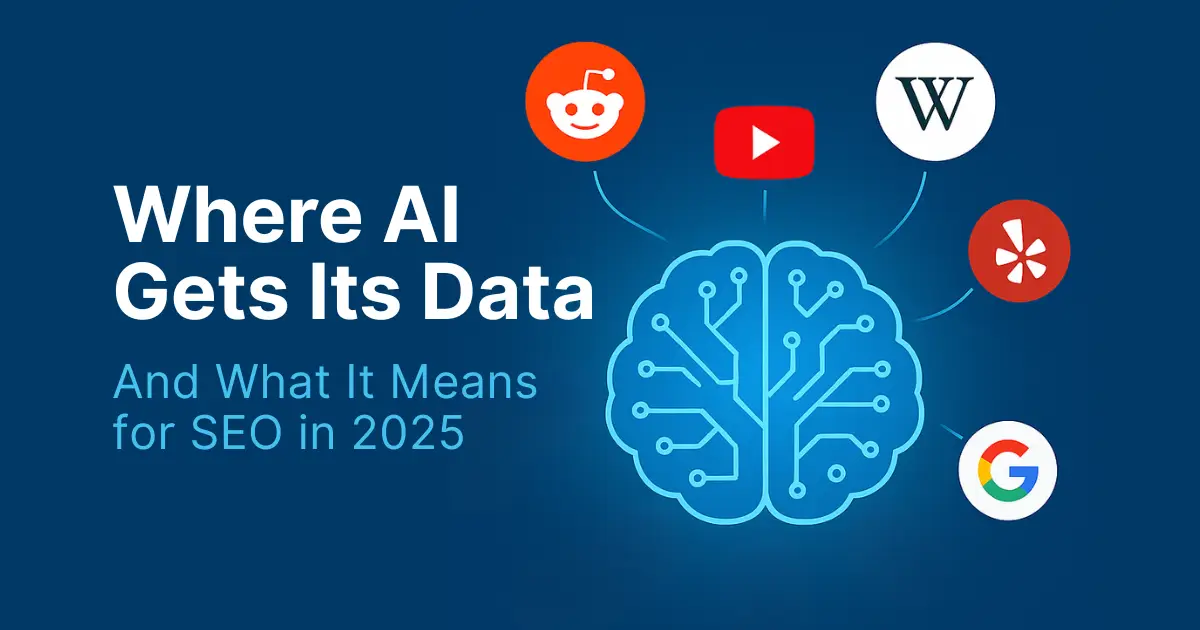
If you need the bigger strategic backdrop first, start with AI Local SEO in 2026, then review where AI gets its data and our AI search optimization guide.
What is an AI Visibility Audit?
An AI Visibility Audit evaluates how likely a business is to be recommended by AI systems like:
- ChatGPT
- Google AI Overviews
- Voice search assistants
- AI-powered local discovery tools
Unlike traditional SEO audits, this is not just about rankings.
It’s about:
- Trust signals
- Entity clarity
- Review sentiment
- Brand presence across the web
At a practical level, this mirrors how search systems still need to crawl, index, and interpret the content and metadata on a page before deciding what to surface. Google's own documentation on how Search works is useful background here.
Think of it as:
“How visible and trustworthy your business is in the eyes of AI.”
If you want a productized view of what this looks like in practice, see Rankley's AI Visibility workflow.
Why Are AI Visibility Audits Easier to Sell Right Now?
This is not just a new service. It’s a timing advantage.
Most agencies are still selling:
- SEO audits
- Rank tracking
- Keyword reports
But clients are starting to ask:
- “Why am I not showing up in AI results?”
- “Why is ChatGPT recommending my competitors?”
That question is only becoming more common as AI-assisted discovery expands across local search, maps, and answer engines. If a client already understands reviews, Google Business Profile, and local rankings, you can connect AI visibility to outcomes they already care about instead of inventing a brand-new problem from scratch.
Right now:
- There is no standard service
- There is no clear reporting framework
- And there is high curiosity from clients
👉 That’s your opportunity.
Agencies that move early can:
- Differentiate instantly
- Charge premium pricing
- Own the conversation
For agencies already selling local SEO audits, AI visibility audits are a natural extension rather than a separate service category.
Step 1: How Do You Identify the Best Prospects for AI Visibility Audits?
Before you sell anything, you need to identify who actually needs this.
Look for businesses that:
- Have decent SEO but low brand presence
- Have competitors dominating reviews
- Appear inconsistently across directories
- Are not mentioned outside their website
You can position outreach like this:
“We built a new AI visibility audit and ran one on your business. Here’s what we found.”
This works because:
- It’s not a generic SEO pitch
- It’s new and intriguing
- It feels tailored
If you already run outbound for local SEO services, this fits well with a prospecting workflow: lead with a finding, not a pitch.
Step 2: What Should an AI Visibility Audit Include?
Now comes the core of the service.
An AI visibility audit is based on a set of signals that AI systems use to decide who to recommend.
Here are the key ones:
1. Entity Clarity
AI needs to clearly understand:
- What the business is
- Where it operates
- What services it offers
Check:
- Business name consistency
- Category alignment
- Service clarity on website
2. Review Volume & Sentiment
AI heavily favors:
- Businesses with strong review signals
- Positive sentiment
- Consistent activity
Look at:
- Total number of reviews
- Keywords inside reviews
- Recency of feedback
If you want a primary-source reference for how reviews influence trust and visibility on Google surfaces, Google's Tips to get more reviews is a useful supporting resource.
3. Directory Presence
AI pulls data from sources like:
- Yelp
- BBB
- Apple Maps
- Bing Places
The more consistent your presence, the stronger your signal.
For Apple-specific local discovery, Apple Business Connect is the direct source for how businesses manage their presence across Maps, Siri, Wallet, and related Apple experiences.
4. Website Content Alignment
Does the website clearly match:
- Services
- Locations
- User intent
AI looks for clarity, not just keywords.
5. Brand Mentions
This is not just backlinks.
AI looks for:
- Mentions across the web
- References in directories
- Citations in relevant places
6. Engagement Signals
While harder to measure directly, signals like:
- Branded searches
- Click behavior
- Interaction patterns
all contribute to trust.
7. Structured Data & Context
Schema, FAQs, and structured content help AI:
- Understand context
- Extract key information
- Build confidence in recommendations
If you need a technical reference point, Google's structured data documentation is the clearest baseline for how search engines interpret machine-readable page context.
This is also why clean, AI-readable pages matter. If you want examples, read how local service businesses can appear in ChatGPT searches and AI SEO: where AI gets its data.
Step 3: How Should You Package an AI Visibility Audit for Clients?
This is where most agencies fail.
They:
- Dump data
- Overwhelm clients
- Don’t tell a story
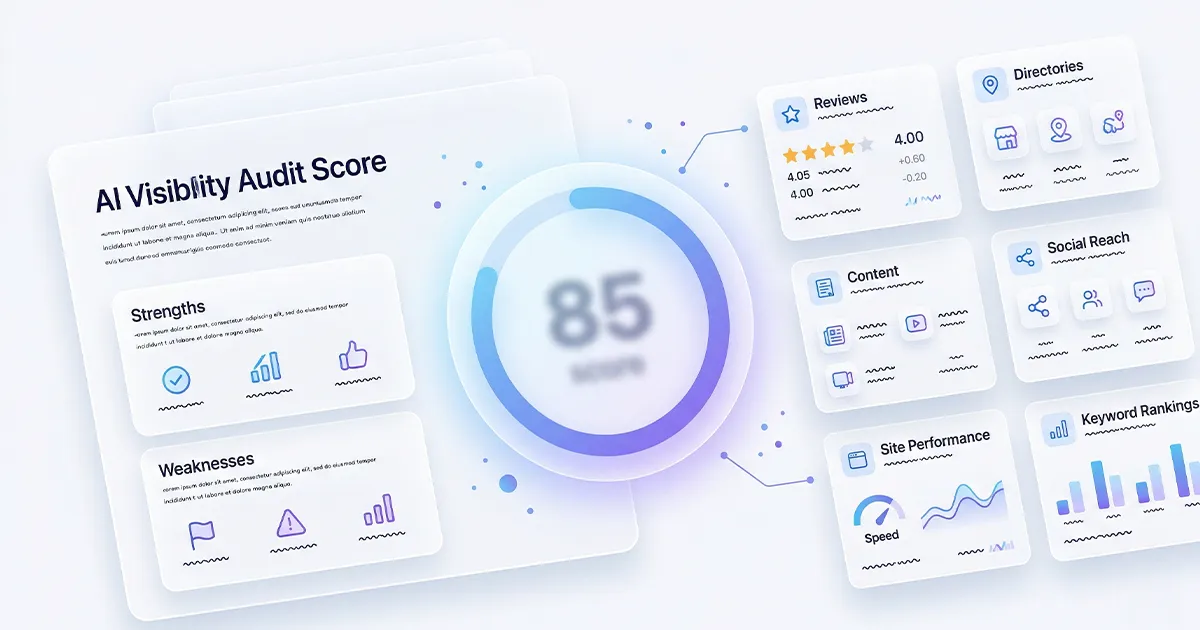
Instead, your report should:
✅ Show a clear score
Example:
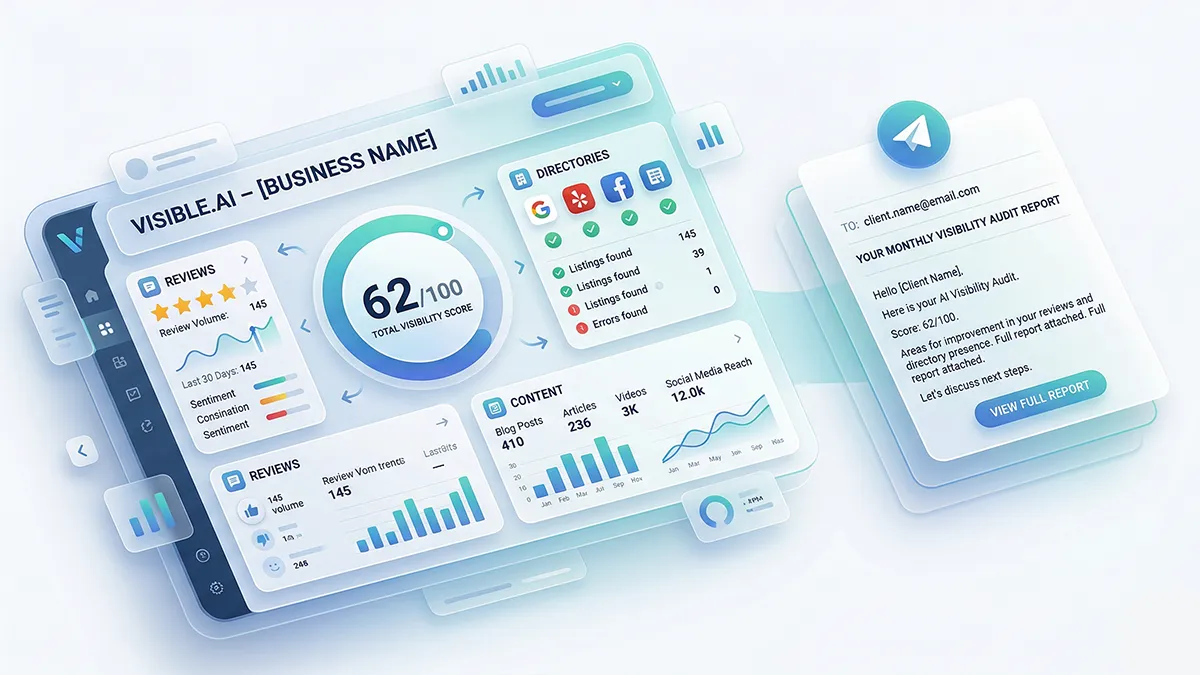
AI Visibility Score: 62/100
✅ Highlight strengths
- Strong review profile
- Good directory coverage
✅ Identify weaknesses
- Low brand mentions
- Weak service page clarity
✅ Provide actionable recommendations
The goal is not to hand over raw observations. The goal is to create a report a local business owner can understand in five minutes and an agency can turn into follow-on work. If you already use white-label reporting, this becomes much easier to standardize.
Step 4: How Do You Close the Deal and Upsell Ongoing Work?
Once you present the audit, the conversation becomes easy.
Because now the client sees:
- Where they stand
- What they’re missing
- What competitors are doing better
You can then offer:
🔹 One-Time Audit
- $99 – $499 depending on depth
🔹 Optimization Package
- Fix issues identified in audit
🔹 Monthly AI Visibility Monitoring
- Ongoing reports
- Continuous improvements
This is where the service shifts from a one-off audit into recurring revenue. The audit opens the conversation, and the monitoring package keeps the client bought into ongoing visibility improvements.
The AI Visibility Signals (Simplified Framework)
To make this repeatable, you need a framework.
Here’s a simplified version:
| Signal | What It Measures |
|---|---|
| Entity Clarity | Business consistency & definition |
| Reviews | Trust & sentiment |
| Directories | Presence across platforms |
| Content | Relevance & clarity |
| Mentions | Authority & awareness |
| Engagement | User interaction signals |
| Structure | Data clarity for AI |
👉 We’ve turned this into a full scoring system inside our checklist.
Download the AI Visibility Audit Checklist
If you want a repeatable system you can use with every client:
👉 Download the AI Visibility Audit Checklist (Notion Template)
Inside, you’ll get:
- Full scoring system
- Step-by-step audit process
- Client-ready structure
- Repeatable workflow
You can also pair this with Rankley pricing if you want to productize the offer around software-assisted delivery instead of manual audit work.
How to Scale This Without Doing Everything Manually
At first, you can run audits manually.
But as you grow, this becomes:
- Time-consuming
- Hard to standardize
- Difficult to scale
That’s where tools come in.
Platforms like Rankley help agencies:
- Generate reports instantly
- Standardize audit frameworks
- Create shareable client reports
- Scale outreach and delivery
If you are building this service line, combine this article with AI Local SEO in 2026 for positioning and how local service SMBs can appear in ChatGPT searches for implementation guidance you can reuse in client recommendations.
FAQ: How Do You Sell AI Visibility Audits to Local Clients?
How much should you charge for an AI visibility audit?
Most agencies start with a one-time audit priced anywhere from $99 to $499, depending on depth, competition research, and reporting detail. Higher-ticket versions usually include competitor comparisons, recommendations, and a live walkthrough.
What should an AI visibility audit include?
A strong audit should cover entity clarity, review signals, directory consistency, website content alignment, structured data, brand mentions, and practical next steps. In other words, it should explain both why AI may not recommend a business and what to fix first.
Is an AI visibility audit a one-time service or a monthly retainer?
It can be either, but the easiest sales motion is to use the audit as the entry offer and then upsell monthly monitoring or implementation. The audit creates urgency; the retainer turns that urgency into ongoing work.
How do you explain AI visibility audits to local business owners?
Keep it simple: tell them the audit shows how likely their business is to be recommended by AI tools like ChatGPT and Google AI experiences. Most owners do not care about technical language; they care whether AI can trust, understand, and recommend their business over nearby competitors.
Final Thoughts
AI is not replacing local search. It’s reshaping it.
And with that shift comes a new opportunity:
👉 Agencies that understand AI visibility early will win.
By offering AI visibility audits, you can:
- Stand out from competitors
- Provide real value to clients
- Create new revenue streams
And most importantly:
You position yourself as the agency that understands what’s next, not just what worked before.
Next Step
Start simple:
- Run your first AI visibility audit
- Package it into a clear report
- Share it with a prospect
You’ll quickly see:
👉 This is not just a service. It’s a new category.

Published by Rankley Editorial
The Rankley team shares practical guides, tools, and insights to help local businesses get found online.